European Accessibility Act and WordPress: 2026 Compliance Guide
If you run a WordPress site that sells anything into the European Union, the European Accessibility Act now applies to you. This post is the strategic and legal companion to the technical WCAG 2.2 audio checklist. Here we cover who is covered, what you must do at a business level, the penalties already being issued, and the accessibility statement that most WordPress owners still ignore.
Why the EAA matters for WordPress in 2026
The European Accessibility Act, formally Directive (EU) 2019/882, has been law since 2019. Enforcement started on 28 June 2025. New services placed on the EU market after that date must comply now. Existing services have until 28 June 2030 to align, but only if they remain unchanged. Most WordPress sites get redesigned or relaunched within five years, which resets the clock.
The European Commission estimates that roughly 87 million people in the EU live with some form of disability. The directive is built around that audience. It standardizes accessibility obligations across all 27 member states so a French ecommerce site and a German banking app face the same baseline rules.
In our audits across the Nordics, we see the same pattern. WordPress owners assume the law targets large corporations. It does not. A boutique Shopify-rival running WooCommerce with a few hundred orders a month is in scope the moment it ships to Berlin or Paris.
Who is covered
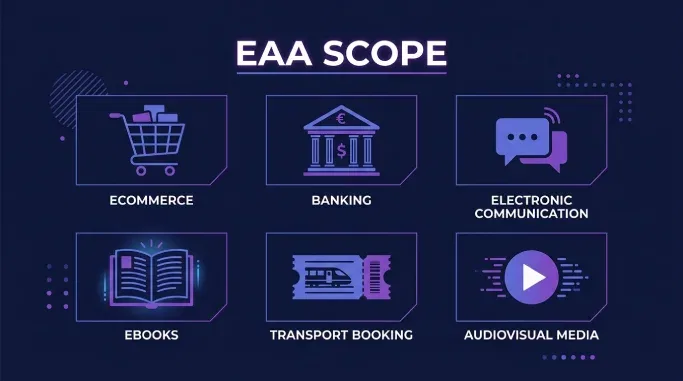
The EAA targets specific categories of products and services. For WordPress site owners, the relevant service categories are:
- Ecommerce websites and apps selling goods or services to consumers
- Consumer banking services, including online banking portals
- Electronic communication services, such as messaging and VoIP
- Ebooks and ereader software
- Passenger transport booking services for air, bus, rail, and waterborne travel
- Audiovisual media services, including streaming platforms and on-demand catalogues
The directive applies to both EU-established businesses and non-EU businesses that place services on the EU market. A US publisher running WordPress that sells digital subscriptions to French readers is covered. A Norwegian agency that builds a WooCommerce shop targeting German customers is covered.
One useful boundary: B2B services are generally out of scope. The EAA targets consumer-facing services. A SaaS dashboard sold only to enterprise IT teams sits outside the directive. A public-facing WooCommerce store sits firmly inside it.
The microenterprise exemption, and what it really means
The directive carves out an exemption for very small businesses, but the rules are stricter than most people think. To qualify as a microenterprise under the EAA, you must meet both criteria:
- Fewer than 10 employees
- Annual turnover OR balance sheet total under 2 million EUR
And there is a critical limitation. The exemption applies only to service providers. If you manufacture or import physical products covered by the EAA, the exemption does not protect you. A small hardware vendor still has full obligations.
Exempt does not mean invisible either. Member states retain the right to ask exempt businesses to notify authorities if requested, and some are using that power. In our audits, we see microenterprise owners assuming they can skip everything. That is risky. The exemption can be reviewed, your headcount can grow, and customers increasingly expect accessibility regardless of your legal status.
The disproportionate burden clause
Article 14 of the directive lets businesses claim a disproportionate burden exemption for specific requirements if compliance would impose an excessive financial or organizational load. It is not a free pass. You must document the assessment, including costs, benefits to users with disabilities, and the size and resources of your business.
Authorities in Germany and France have already signalled that misuse of this clause will be treated as non-compliance. If you claim disproportionate burden without a paper trail, you face the same penalties as a business that ignored the law entirely.
What the law actually requires of a WordPress site
The EAA itself is a directive. It sets goals but defers the technical detail to a harmonised standard. That standard is EN 301 549, maintained by ETSI in cooperation with CEN and CENELEC. EN 301 549 currently maps directly to WCAG 2.1 Level AA for web content.
The November 2025 draft EN 301 549 V4.1.0 updates clauses 9, 10, and 11 to align with WCAG 2.2 AA. The final V4.1.1 is expected to be referenced in the Official Journal of the European Union in October 2026. For now, treat WCAG 2.1 AA as the operational target and prepare for WCAG 2.2 within the next refresh cycle.
For the criterion-by-criterion technical breakdown of audio players, contrast, focus indicators, target size, and ARIA, see the technical WCAG 2.2 audio checklist. The rest of this post focuses on the legal and operational duties that sit on top of those technical rules.
The accessibility statement nobody talks about
Article 13 of the EAA, implemented through national laws, requires covered services to publish an accessibility statement. This is not the same as a privacy policy or a cookie banner. It is a formal public document describing the accessibility status of your service.
A compliant accessibility statement should contain:
- The name of the service and its URL
- A conformance status: fully, partially, or non-compliant with WCAG 2.1 AA via EN 301 549
- A list of non-accessible content and the reason, including any disproportionate burden claims
- The date the statement was prepared and last reviewed
- A feedback mechanism so users can report accessibility barriers
- Contact details of the body responsible for enforcement in the relevant member state
In our audits, the accessibility statement is the single most common omission. Teams fix focus indicators and alt text, then forget the document that signals compliance to regulators and users. A missing or outdated statement is one of the easiest violations for authorities to flag because it is visible from outside the site.
Penalties by member state
The directive lets each member state set its own penalty regime. The result is a patchwork, and the high end is high enough to matter.
| Member state | Maximum fine | Notes |
|---|---|---|
| Germany | Up to 100,000 EUR per violation | Germany’s Accessibility Strengthening Act (BFSG) took effect on June 28, 2025. |
| France | Up to 25,000 to 50,000 EUR in certain accessibility enforcement cases | French accessibility enforcement may include penalties for missing accessibility statements and non-compliant digital services under RGAA and EAA-related rules. Confirm exact penalty amounts and responsible authority guidance with Arcom and DGCCRF before publication. |
| Italy | Up to 5 percent of annual turnover in certain cases, or administrative fines up to 40,000 EUR | The 5 percent turnover penalty appears tied to Italy’s Legge Stanca framework and may apply primarily to large private entities. Confirm scope, responsible entity definition, and applicability under D.Lgs. 82/2022 and current AgID guidance before publication. |
| Multiple member states | Periodic penalty payments and escalating enforcement measures | Some EU member states may impose recurring daily penalties or coercive payments for ongoing non-compliance after notice. Confirm exact amounts and enforcement structures separately for Spain, Ireland, and the Netherlands before publication. |
Money is not the only consequence. Authorities can order a service suspended or a product removed from the market. For a WordPress ecommerce business that depends on EU customers, suspension is the real risk. A 50,000 EUR fine hurts. A two-week takedown during the holiday season is fatal.
The Nordic and EEA situation
Norway is in the EEA, not the EU. The EAA is still under formal assessment by the EFTA states, but Norwegian WordPress owners should not assume they have extra time. Norway already enforces equivalent obligations through Likestillings- og diskrimineringsloven and the related WAD-forskrift (forskrift om universell utforming av IKT-løsninger). Supervision sits with Digdir, the Norwegian Directorate for Digital Transformation, through uu-tilsynet.
Digdir can issue daily fines for ongoing non-compliance. In practice, the technical baseline is the same as the EAA: WCAG 2.1 AA via EN 301 549. We tell our Norwegian clients to assume EAA-equivalent rules apply today, because they functionally do.
Sweden, Denmark, and Finland each transpose the EAA into existing national accessibility frameworks rather than creating new structures. In Sweden, supervision sits with the Agency for Digital Government (DIGG). In Denmark, it sits with Digitaliseringsstyrelsen. In Finland, with the Regional State Administrative Agency for Southern Finland. The obligations align, the enforcement bodies differ.
How non-EU businesses get pulled in
This trips up more US, UK, and Norwegian site owners than any other rule. The EAA applies based on where you place a service on the market, not where you are headquartered.
Regulators look at signals of geographic targeting:
- Do you display EUR pricing or accept payment in EUR?
- Do you offer shipping or service delivery to EU member states?
- Do you publish content in an EU national language aimed at that market?
- Do you run paid advertising targeted at EU users?
- Do you use an EU country-code top-level domain like .de or .fr?
If two or more of those apply, assume you are placing a service on the EU market. A US WooCommerce store with EUR pricing and DHL shipping to Germany is covered. A Norwegian publisher running a WordPress site translated into Swedish is covered. Headquarters location is not the test.
How audio narration helps with EAA conformance
Audio narration of written content is not a hard legal requirement of the EAA. The directive does not say "all articles must have an audio version". What it does say is that services must support a range of access methods for users with sensory and cognitive disabilities.
Audio narration of article text functions as a media alternative for text under WCAG terminology. It is the same content delivered through a different sensory channel. It materially improves the experience for users with:
- Dyslexia, who process spoken language more comfortably than long passages of written text
- ADHD, who benefit from audio that keeps attention anchored
- Low vision, who may not use a full screen reader but want larger-text-plus-audio
- Cognitive disabilities, where multimodal delivery aids comprehension
This is not a substitute for keyboard navigation, focus indicators, alt text, or any other WCAG requirement. It is a complement. If you are building accessibility into a WordPress site for 2026, text to speech narration is a low-cost addition that demonstrates commitment to users beyond the legal minimum. We document the technical settings in our accessibility configuration.
A practical 30-day plan for WordPress owners
Most of our clients move from "we should look at accessibility" to "we are compliant enough to publish a statement" within a month. The plan looks like this:
- Days 1 to 5. Audit against WCAG 2.1 AA. Run automated tools (Axe, WAVE, Lighthouse) and supplement with manual keyboard-only testing and a screen reader pass using NVDA on Windows or VoiceOver on macOS.
- Days 6 to 10. Triage findings by impact. Focus on forms, contrast ratios, keyboard traps, missing focus indicators, and target size on mobile. These are the failures that block real users and attract regulator attention.
- Days 11 to 20. Remediate the highest-impact failures. Fix what blocks core user journeys first: checkout, contact, search, navigation. Cosmetic issues can wait one release cycle.
- Days 21 to 25. Document the remediation timeline. Anything you cannot fix in 30 days needs a written plan with target dates. Authorities accept good-faith progress. They do not accept silence.
- Days 26 to 28. Publish your accessibility statement. Use the template above. Link it from the footer of every page.
- Days 29 to 30. Add a feedback channel. A dedicated email address, a form, or a contact link inside the statement. Monitor it and respond within 14 days.
The WebAIM Million report consistently finds that over 95 percent of top home pages have detectable WCAG failures. That means most of your competitors are out of compliance too. The work is not glamorous, but the bar to clear is lower than the headlines suggest.
Frequently asked questions
Does the EAA apply to my WordPress site if I am based in the US?
Yes, if you sell covered services to EU consumers. The test is geographic targeting, not company headquarters. If you accept EUR payments, ship to EU member states, publish in an EU national language, or advertise to EU users, you are placing a service on the EU market. A US WooCommerce store with German-language product pages and shipping to Berlin is fully in scope.
I have under 10 employees. Am I really exempt?
Only if you also have annual turnover or balance sheet under 2 million EUR, and only if you are a service provider rather than a product manufacturer. Member states can still require notification from exempt businesses. The exemption is real but narrow, and it does not protect you from customer expectations or future growth past the threshold. Many small businesses choose to comply anyway.
When will the EAA reference WCAG 2.2 instead of 2.1?
The harmonised standard EN 301 549 is being updated. The November 2025 draft V4.1.0 updates clauses 9, 10, and 11 to align with WCAG 2.2 AA, and the final V4.1.1 is expected to be referenced in the Official Journal of the European Union in October 2026. Until the updated EN 301 549 is formally adopted and referenced in EU implementing acts, WCAG 2.1 AA remains the operational target. Plan for WCAG 2.2 in your next refresh cycle.
What goes into an accessibility statement?
Six elements: the service name and URL, a conformance status against WCAG 2.1 AA via EN 301 549, a list of non-accessible content with reasons, the preparation and review dates, a feedback mechanism for users to report barriers, and contact details of the national enforcement body. The statement must be public, easy to find, and reviewed regularly. A footer link from every page is the standard pattern.
Can I rely on an accessibility widget for compliance?
No. Overlay widgets that promise one-click compliance do not meet EAA or WCAG requirements. They often make accessibility worse for screen reader users by injecting conflicting ARIA. Authorities in Germany and France have explicitly stated that widgets do not substitute for proper remediation. Use them as a small enhancement at most, never as your compliance strategy.
Does my WooCommerce store count as ecommerce under the EAA?
Yes. The directive covers any online service that allows consumers to buy goods or services. A WooCommerce store selling physical products, digital downloads, or subscriptions to EU consumers falls inside the scope. The product itself may or may not be covered, but the purchasing service almost always is. Cart, checkout, account creation, and order confirmation pages all need to meet WCAG 2.1 AA.
What happens if I ignore the law?
Enforcement is reactive in most member states. Authorities act on complaints from users, competitors, or advocacy groups. Once a complaint is filed, you typically receive a notice with a remediation deadline. Ignoring the notice triggers fines, daily penalties, or service suspension orders. The cheapest path is to publish an honest accessibility statement and fix the highest-impact failures within a few months.
Where to start
The single most useful first action is publishing an accessibility statement, even an imperfect one. It signals to regulators and users that you take the obligation seriously, and it forces an honest audit of where your site stands. From there, the remediation work follows naturally.
If you run WordPress, pair the technical work in the technical WCAG 2.2 audio checklist with the legal steps in this post. The combination is what brings a real site into EAA conformance, not just the standard. For audio narration specifically, see our accessibility configuration for the player settings that pair best with screen readers and keyboard navigation.